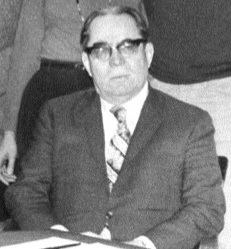
Halil İbrahim İnalcık (7 September 1915, Istanbul – 25 July 2016, Ankara) was an internationally renowned Turkish historian, author, and academic. He is known for his original contributions to Ottoman and Turkish history in the political, economic, cultural, and civilizational fields. On account of his scholarly works and the students he trained, he was referred to by the titles "Shaykh al-Mu'arrikhin" (Master of Historians) and "Pole of Historians."
Coming from a family of Crimean émigrés, İnalcık graduated in 1940 from the Faculty of Languages, History, and Geography of Ankara University, which he had entered in 1936. In 1942 he completed his doctorate with a thesis titled The Tanzimat and the Bulgarian Question. He became an associate professor in 1943 and a professor in 1952. In the course of his academic career he lectured at Ankara University, Bilkent University, the University of Chicago, the University of London, Harvard University, and Princeton University. His works The Ottoman Empire: The Classical Age (1300–1600) and An Economic and Social History of the Ottoman Empire, written in English, were translated into many languages, including the Balkan languages and Arabic, and were taught as textbooks in many universities around the world.
After serving for 32 years at the Faculty of Languages, History, and Geography of Ankara University, İnalcık founded the Chair of Ottoman History at the University of Chicago in 1972, and the Department of History at Bilkent University in 1993. Among his doctoral students are many historians, including İlber Ortaylı. In 2016, at the age of 100, he died in Ankara, and by decision of the Council of Ministers his body was buried in the Hazire (graveyard) of the Fatih Mosque.
Life
İnalcık was born in Istanbul on 7 September 1915. His father was Seyit Osman Nuri Bey, one of the Crimean émigrés, and his mother was Ayşe Bahriye Hanım. His family settled in Ankara in 1924.
Between 1923 and 1930 he attended the Ankara Gazi School, and for one year the Sivas Teachers' School. After completing his secondary education in 1931 at the Gazi Teachers' School in Ankara, he continued his high-school education at the Necati Bey Teachers' School in Balıkesir. In 1936 he began his higher education in the Department of Modern History at the Faculty of Languages, History, and Geography of Ankara University. After graduating in 1940, he remained at the faculty as an assistant.
In 1942 he submitted his doctoral thesis titled The Tanzimat and the Bulgarian Question. In 1943 he was appointed associate professor with a thesis titled The Ottoman Empire and the Crimean Khanate up to the 'Great Retreat' from Vienna. In 1945 he married Şevkiye Işıl of the Department of Arabic Language and Literature of the Faculty of Languages, History, and Geography of Ankara University.
Lecturing for many years at the same faculty on Ottoman and European history, İnalcık was elected a member of the Turkish Historical Society (TTK) in 1947. In 1949 he went to England and worked on Turkish manuscripts at the British Museum, and in the Calendar of State Papers series he collected records pertaining to Ottoman history. At the Public Record Office he carried out a survey of sources concerning the Ottoman Empire. He returned to Turkey in 1951.
In the summer of 1951 he began working on the Bursa Sharia Court Registers. As a result of his initiatives, the registers were bound and cleaned in the workshop at Topkapı Palace and sent back to Bursa. In June 1952 İnalcık received the title of professor with a thesis titled Ottoman–Crimean Khanate Cooperation in the Years of the Vienna Defeat.
Serving as a visiting professor at Columbia, Princeton, Pennsylvania, and Harvard Universities, İnalcık retired from Ankara University in 1972 and founded the Chair of Ottoman History at the University of Chicago. In 1973 his book The Ottoman Empire: The Classical Age 1300–1600 was published.
His Death
Halil İnalcık died at the age of 100 on 25 July 2016 at 19:10 at the hospital where he was being treated in Ankara, due to multiple organ failure. After his death, ceremonies were held at Bilkent and Ankara Universities. By decision of the Council of Ministers, his body was buried in the Hazire of the Fatih Mosque, where the tomb of Fatih Sultan Mehmet is also located.
After his death, memorial ceremonies were held for İnalcık in many places, and by the instruction of President Recep Tayyip Erdoğan a special grave was made for him. Arranged in the style of traditional Ottoman graves, İnalcık's "scholar's grave" (ulema kabri) was completed on 22 July 2017. The inscriptions and motifs of the marble grave were adorned with gold leaf.
In the design of the grave, the grave of Ahmed Cevdet Paşa was taken as a model. The Istanbul Directorate of Culture and Tourism and the Istanbul Governorship undertook the coordination, and financial support was provided by the Istanbul Mausoleums Association. Two cylinders ("üstüvani") were erected on the grave, at the foot and at the head. Semih İrteş had the stones made, while Sabri Mandıracı wrote the classical ornamentation of the cylinder at the foot. Mandıracı's work was executed by hand.
Principal Works
The Ottoman Empire: The Classical Age 1300–1600, London, 1974.
Studies in Ottoman Social and Economic History, London, 1985.
The Middle East and the Balkans under the Ottoman Empire, Bloomington, 1993.
Süleyman the Second and His Time, Istanbul, 1993.
An Economic and Social History of the Ottoman Empire (with Donald Quataert), Cambridge, 1994.
From Empire to Republic: Essays on Ottoman and Turkish Social History, Istanbul, 1995.
Sources and Studies on the Ottoman Black Sea, Cambridge, 1995.
History of Humanity (editor, with Peter Burke), 1999.
Ottoman Civilization (with Günsel Renda), Ankara, 2003.
Essays in Ottoman History, Eren Yayıncılık.
Osmanlı tarihinde İslamiyet ve Devlet (Islam and the State in Ottoman History), Türkiye İş Bankası Kültür Yayınları.
Makaleler 1: Doğu Batı (Articles 1: East West), Doğu Batı Yayınları, 2005.
Fatih devri üzerinde tetkikler ve vesikalar (Studies and Documents on the Era of the Conqueror), Ankara, 1954.
Osmanlı'da Devlet, Hukuk, Adalet (State, Law, and Justice in the Ottomans), Eren Yayıncılık, 2000.
Osmanlı İmparatorluğu'nun Ekonomik ve Sosyal Tarihi (An Economic and Social History of the Ottoman Empire) Vol. 1 / 1300–1600, Eren Yayıncılık, with Prof. Dr. Donald Quataert, 2001.
Osmanlı İmparatorluğu'nun Ekonomik ve Sosyal Tarihi (An Economic and Social History of the Ottoman Empire) Vol. 2 / 1600–1914, Eren Yayıncılık, 2004.
Osmanlı İmparatorluğu - Toplum ve Ekonomi (The Ottoman Empire: Society and Economy), Eren Yayıncılık.
Osmanlı İmparatorluğu Klasik Çağ (The Ottoman Empire: The Classical Age) (1300–1600), Yapı Kredi Yayınları, 2003.
Tanzimat ve Bulgar Meselesi (The Tanzimat and the Bulgarian Question), Eren Yayıncılık.
ABD Tarihi (History of the USA), Allan Nevins/Henry Steele Commager (translation), Doğu Batı Yayınları, 2005.
Şair ve Patron (Poet and Patron), Doğu Batı Yayınları, 2003.
Balkanlar (The Balkans) (with Prof. Dr. Erol Manisalı).
Atatürk ve Demokratik Türkiye (Atatürk and Democratic Turkey), Kırmızı Yayınları, 1st ed.: July 2007 – 2nd ed.: December 2007.
Sources
- Turkish Wikipedia: tr.wikipedia.org
- English Wikipedia: en.wikipedia.org