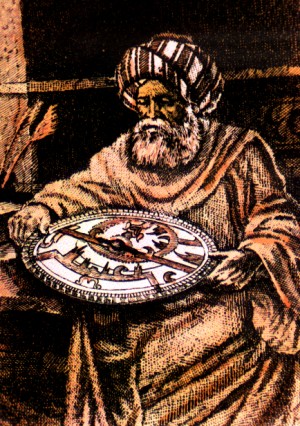
Abū ʿAbdullāh Muḥammad ibn Jābir ibn Sinān al-Raqqī al-Ṣābiʾ al-Battānī (Arabic: محمد بن جابر بن سنان البتاني) (858, Harran – 929, in the district of Qaṣr al-Jiṣṣ near Samarra), known in Latin as Albategnius, Albategni or Albatenius, was an Arab astronomer, astrologer and mathematician. He was born in Harran, now a district of the province of Şanlıurfa in Turkey. His epithet is al-Ṣābiʾ, but his full kunya leads us to the conclusion that he was a Muslim.
Astronomical work
One of al-Battani's best-known achievements in astronomy is that he measured the solar year as 365 days, 5 hours, 46 minutes and 24 seconds.
Al-Battani's work known as Kitāb al-Zīj al-Ṣābiʾ (كتاب الزيج الصابئ) had a great influence on European astronomers such as Johannes Kepler and Tycho Brahe. Although the Zij was translated into Latin three times, Nicolaus Copernicus repeated in his works whatever al-Battani, who lived some 700 years before him, had written.
The modern world has shown al-Battani its respect and reverence for his contributions to the world of science and named a region on the Moon Albategnius after him.
Al-Battani carried out his work in Raqqa in Syria and in Damascus, the city where he died. Al-Battani corrected some of Ptolemy's errors and compiled new tables of the Sun and Moon. He was long accepted as an authority in the world of science. He discovered the perigee motions of the Sun, worked on the divisions of the celestial sphere, and — probably independently of the Indian astronomer Aryabhata, who lived in the 5th century — explained the uses of the sine, and partly of the tangent, in calculation, thus laying the foundation of modern trigonometry. Apart from these, al-Battani calculated in astronomy the values of the precession of the equinoxes and the obliquity of the ecliptic, finding a very close ratio. In his tables, al-Battani used uniform evaluations for the precession.
His most important work, the Zij or adjusted astronomical tables — his work titled al-Zīj al-Ṣābiʾ, consisting of 57 chapters, translated into Latin by Plato of Tivoli in 1116 as De Motu Stellarum — left a great influence on European astronomy. The Zij was constructed upon Ptolemaic theory with some Indian influence. A new edition of this work appeared in Bologna in 1645. The copy written in Plato's own hand is in the Vatican; and a manuscript treatise written by al-Battani is preserved in the astronomical chronology section of the Escorial Library.
Mathematics
In mathematics, al-Battani produced formulas used in trigonometry today:
{\displaystyle \tan a={\frac {\sin a}{\cos a}}}
{\displaystyle \sec a={\sqrt {1+\tan ^{2}a}}}
He also found the equality sin x = a cos x, formula:
{\displaystyle \sin x={\frac {a}{\sqrt {1+a^{2}}}}}
Al-Battani used al-Marwazi's idea of the tangent, compiling his mathematical tables on the subject in order to develop equations for the calculation of the tangent and cotangent. Beyond this he discovered the reciprocal functions of the secant and cosecant and prepared the first mathematical table on cosecants — which he called the table of shadows — so as to include each degree from 1 to 90.
His renown
Western scholars for years referred to the Moon by his name.
The crater Albategnius on the Moon is named in his honor.
In the film Star Trek: Voyager, the Excelsior-class starship USS Al-Batani [sic] NCC-42995 is named after him as Kathryn Janeway's first space mission.
He was the first Muslim scientist whose works were translated into Latin in the medieval Western world.
The author Kosta Kortidis devoted extensive space to al-Battani in his work titled "Malulen Emekli Gökbilimci Hüseyin Çineli" (The Disabled Retired Astronomer Hüseyin Çineli). In the game of chess, on the chessboard he named "scientists' chess," al-Battani came to life as the "knight."
Sources
- Turkish Wikipedia: tr.wikipedia.org
- TDV Encyclopedia of Islam: islamansiklopedisi.org.tr
- English Wikipedia: en.wikipedia.org