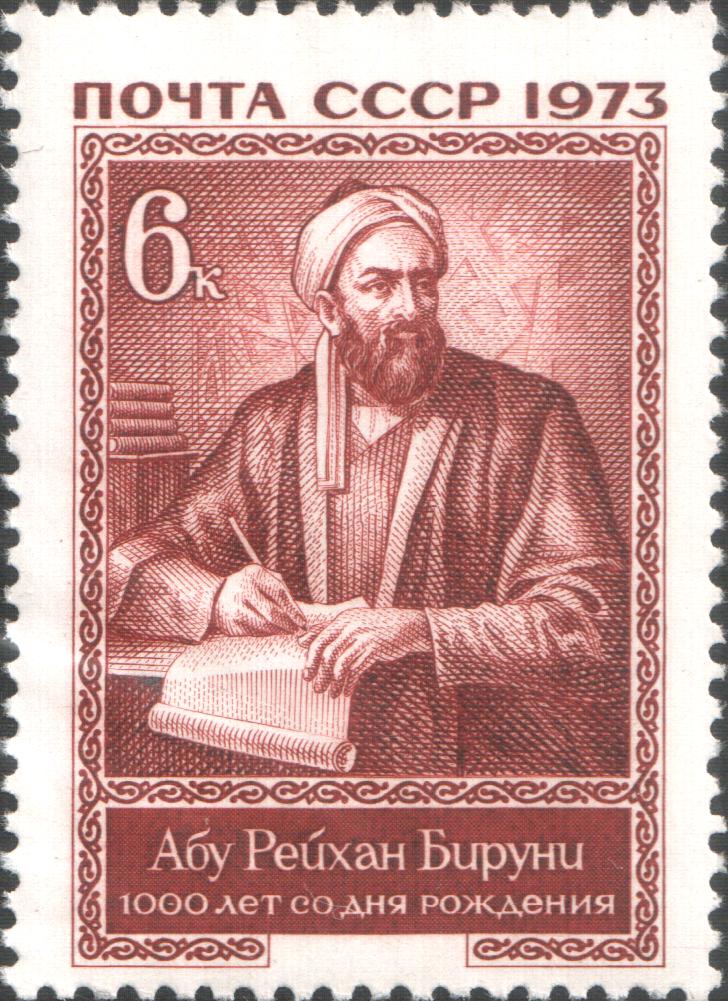
Al-Biruni (4 September 973, Kath - 13 December 1048, Ghazni) was a polymath (hezârfen) known for his work during the Golden Age of Islam. His full name is Ebu Reyhan Muhammed bin Ahmed el-Bîrûnî (Persian: بیرونی, Arabic: ابو الريحان محمد بن احمد البيروني).
In Western languages his name appears as Alberuni or Aliboron. He is known for his work in the fields of mathematics, the natural sciences, geography, history, and medicine.
Life
Al-Biruni was born in Khwarezm, a historical region in Central Asia. He lost his father at a young age. In Khwarezm he was protected by the Afrigid (Âl-i Irak) dynasty and received an education in mathematics and astronomy at the court. His teachers there were İbn-i Irak and Abdussamed bin Hakîm. During this period, while still only 17, he wrote his first book. When Khwarezm passed under the rule of the Ma'munid dynasty, al-Biruni went to Iran and lived there for a while. Later he came to be protected by the Ziyarids. He wrote his book titled El-Âsârü'l-Bâkıye (The Remaining Traces) at the court of the Ziyarids. After working here for two years as well, he returned to his homeland and began to work on astronomy and astrology with Ebu'l Vefâ (Abu al-Wafa).
When Mahmud of Ghazni conquered Khwarezm in 1017, al-Biruni too came to the city of Ghazni and came under the protection of the Ghaznavids. He was held in great esteem at the court and took part in Mahmud of Ghazni's campaign to India. There he attracted the attention of Indian scholars, and when the Indian country was taken, he settled in the city of Nandana and continued his scientific work there. Learning Sanskrit, he studied the life and culture of Indian society.
From here he returned again to the city of Ghazni and completed the rest of his life in this city. This period is considered al-Biruni's most productive time. He published his work titled Tahdîdu Nihâyet'il Emâkin, which he had long been preparing, in the year 1025, coinciding with this period. He dedicated his work on astronomy titled Kanûn-i Mes'ûdî (The Mas'udic Canon) to Sultan Mesud (Mas'ud), the son of Mahmud of Ghazni. Al-Biruni died on 13 December 1048.
The general view is that al-Biruni was of Iranian origin. However, some sources state that he was, or may have been, of Turkic origin.
Personality
Al-Biruni presented his best work on astrology to Mesud, the son of Mahmud of Ghazni. When Sultan Mesud thereupon gifted him an elephant's load of silver, he turned this gift down, saying, "This gift would corrupt me and turn me away from science." In fact, al-Biruni attached far greater importance to applied training in pharmacy than to books. Al-Biruni believed that gathering data by handling and observing provides a person far more benefit than reading books, and he put this into practice. Having a true understanding of science, al-Biruni also did not attach importance to the concept of race. He would speak with deep respect of the advanced culture of another people. Likewise, during his account of religions and thoughts, he neither objected to nor criticized those religions, and he is also noteworthy for using the very terms of that religion. In the preface of his book titled Potenceli, which he translated from the Sanskrit language into Arabic, he wrote: "People's thoughts are of various kinds, and the development and well-being of the world rest upon this difference."
Works
A versatile scientist, El-Bîrûnî received his primary education from a Greek scholar. Protected by the Khwarezmian mathematician and astronomer Ebu Nasr Mansur (Abu Nasr Mansur), who came from a renowned and distinguished family, El-Bîrûnî did his first works alongside this scholar. His first work is "Asar-ül Bakiye."
The number of El-Bîrûnî's works is around one hundred and eighty. There are seventy astronomy books and twenty mathematics books. He created an index on medicine, biology, plants, minerals, animals, and useful herbs. However, only twenty-seven of these works have been able to reach the present day. In particular, the fact that al-Biruni's works were not translated into Latin in the Middle Ages is a result of his books having been written in a heavy language. But al-Biruni, as he himself said, was writing his works not for ordinary people but for scholars.
It is also known that al-Khwarizmi's work titled "The Foundations of the Zij" was translated into Hebrew in the 12th century by Abraham ben Ezra. The West's interest in al-Biruni, for its part, began in the 1870s. From that day to this, some of al-Biruni's works, in whole or in part, have been translated into German and English.
From his letters, it is understood that al-Biruni knew Aristotle. Al-Biruni, who worked together with important scholars such as Avicenna (Ibn Sina), went to India many times. For this reason, he wrote a book about India. This book of his was translated into several languages. This book, translated into several languages, became a model for many scholars. Al-Biruni also has one novel.
Mathematics
Al-Biruni's aspect as a mathematician is his best-known aspect. Al-Biruni, the greatest mathematician of the century in which he lived, was the first person to propose that the radius be accepted as a unit in trigonometric functions, and he added the secant, cosecant, and cotangent functions to functions such as sine and cosine. This aspect of al-Biruni could be discovered and used by the Western world only two centuries later.
Al-Biruni's calculation of the length of a meridian arc—by measuring the height of a mountain using trigonometry and then, from this point of known elevation, measuring the angle of the horizon dip—is also an important work in terms of geometry. It is a widespread belief that the length of a meridian arc was found for the first time by al-Biruni with this method. However, al-Biruni stated that he had taken this method from another scholar.
Astronomy
Foremost among the works al-Biruni carried out in the field of astronomy is his work titled "Mesudî fi'l Heyeti ve'n-Nücum," which he presented to Sultan Mesud in 1010. This work has reached the present day, but part of his work on this subject is lost. His making the views of Aristotle and Ptolemy a subject of discussion in his work titled Kanun, and his dwelling on the possibility that the Earth is rotating on its own axis, is important in terms of the history of science. However, no work by al-Biruni on this subject—who is assumed not to have reached a definite conclusion—has reached the present day.
His work titled "Nihâyâtü'l-Emâkin" (Turkish: The Ends of Places) contains his writings on a range of subjects, from geography to geology and geodesy. "El-Kanunü'l-Mesudi," which he presented to Sultan Mesud, is al-Biruni's most important work in the field of astronomy. According to historians of science, al-Biruni laid the foundations of modern astronomy that began with Copernicus.
In addition, through various calculations he made in Kath, Gurganj, and Ghazni, he found values very close to the true one for the inclination of the tension plane relative to the celestial abscissa (the obliquity of latitude). He was also able to calculate many with elements and compounds. Since the determination of longitude is more difficult than that of latitude, al-Biruni went about calculating the longitude difference between two points with a formula based on latitude and the total distance between them, and he strove to reduce the margin of error in his measurements and observations to a minimum. Besides this, by discovering that he would increase sensitivity by dividing his observation instruments into diagonal lines rather than enlarging their size, he laid the foundations of the vernier principle. Below are the numerical values put forward by some scientists who found the value of the ecliptic inclination:
Other sciences
In his work titled "Kitâbü'l-Camahir fi Mârifeti'l-Cevâhir" (Turkish: On the properties of gems), al-Biruni determined the specific gravities of 23 solid substances and six liquids very close to their present-day values. Likewise, al-Biruni, who also wrote a book about the history of India, described in great detail the beliefs, convictions, ways of life, and traditions and customs of the Indians, doing so in a completely impartial manner and far from prejudice.
Sources
- Turkish Wikipedia: tr.wikipedia.org
- TDV Encyclopedia of Islam: islamansiklopedisi.org.tr
- English Wikipedia: en.wikipedia.org