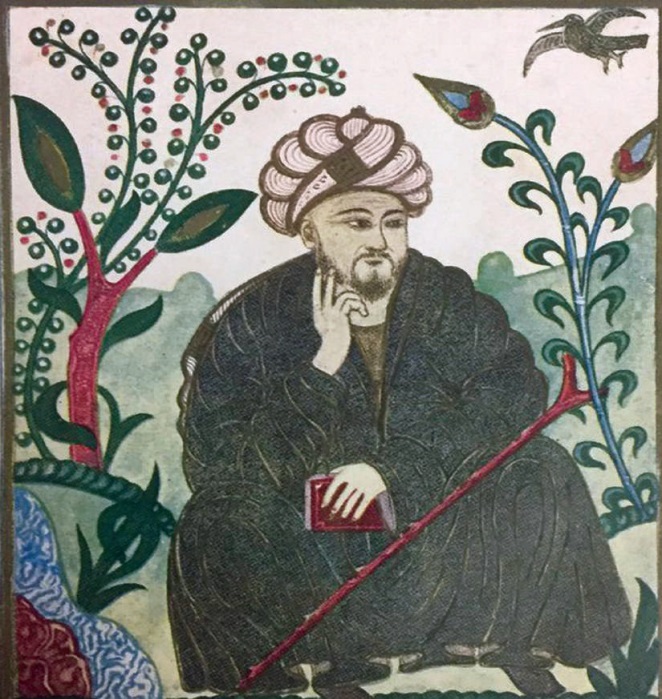
Al-Farabi (Persian: الفارابي) (872, Farab – 950/951, Damascus) was a renowned philosopher and scholar who lived during the Islamic Golden Age between the 8th and 13th centuries. He was also an astronomer, logician, and musician.
Thanks to his contributions and refinements to the science of logic, al-Farabi is known among medieval Islamic intellectuals as Muallim-i Sânî or Hâce-i Sânî (the Second Teacher / Magister secundus). The Hâce-i Evvel (First Teacher / Magister Primus) is Aristotle. Al-Farabi's life, like that of al-Kindi whom he succeeded, is little known. He is known to have resided in Baghdad, Aleppo, and Egypt, and for a significant part of his life to have been supported by the Shia Hamdanid dynasty in Aleppo. His ethnic identity is disputed. According to some sources he was of Persian origin, according to others of Turkic origin. However, al-Farabi wrote all of his works in Arabic. He retranslated many of Aristotle's fundamental works into Arabic and wrote commentaries that made these works more comprehensible. In this respect he both fostered the understanding of ancient philosophy in the Islamic world and made a great contribution to Arabic becoming a language of philosophy.
Beyond this great contribution, the main reason al-Farabi is regarded as the Second Teacher is, according to Ibn Khaldun, his work in the field of logic. Al-Farabi composed translations and commentaries covering all parts of Aristotle's six-volume fundamental work on logic, the Organon, and expanded the Organon to eight volumes by adding two more sections. Because logical expressions are related to the language used to express them and to knowledge, al-Farabi is seen to have dwelt intensively, beyond logic, on the philosophy of language and epistemology. Another of al-Farabi's fields of study was natural philosophy, metaphysics, and psychology. His conception of nature accords with the Ptolemaic geocentric view of the period. The theory of emanation (sudûr) that al-Farabi developed rests on Neoplatonic and Ismaili origins. This conception was later developed by Avicenna. The number of books attributed to al-Farabi ranges between 100 and 160.
Al-Farabi is the second founder of the Peripatetic (Mashshāʾī) movement, which is held to have been founded by al-Kindi and which expresses the rational/Aristotelian tendency within Islamic philosophy. Because he had many followers, some historians of philosophy speak of a Farabian school. The Jewish philosopher Maimonides pays him the greatest praise among the philosophers who influenced him: "As for works on logic, one need study only the works of Abu Nasr al-Farabi. All his works are flawless and excellent. They should be examined and understood, for he is a great man." Although in the West al-Farabi's works were translated less than those of Avicenna and Averroes, his works held a central importance in the renewed understanding of Aristotelian thought and made the first opening toward the philosophical richness that followed. Averroes and the Andalusian philosophers regard al-Farabi as an important authority on logic, psychology, and politics.
Biography
The principal available records concerning al-Farabi's origin and genealogy are not biographies written during his own lifetime—as is likewise the case with his contemporaries—but documents written in later periods on the basis of hearsay or conjecture. The sources on his life story are quite inadequate, yet sufficient to give a general idea about him. The earliest and reasonably reliable sources go back only as far as the 6th/12th century. Although al-Farabi had a significant influence on the world of thought, neither his successors nor his followers nor other researchers prepared a biography of him. The sources predating the 6th/12th century consist of two groups:
An autobiographical fragment written by al-Farabi and preserved by Ibn Abi Usaibia, in which al-Farabi explains how the teaching of logic and philosophy developed from antiquity down to his own day;
the notes of al-Masudi, Ibn al-Nadim, and Ibn Hawqal, along with those of Said al-Andalusi (d. 1070), who devoted a biography to him.
When the principal Arab biographers set out to compose comprehensive biographies of al-Farabi, they had so little information at hand that this gave rise to a series of fabricated stories—ranging from conjectural tales built upon a few known minor details, to tendentiously reconstructed life stories, and even to legends. Many modern biographies of the philosopher written in later periods were in turn derived from this fabricated material. These biographies belonging to the 6th/12th century and after essentially consist of three biographical texts, while the others are based on these three texts or are merely later reworkings of them:
His Name
His full name, as accepted in all sources—especially by al-Masudi, one of the earliest and most reliable—is Abu Nasr Muhammad ibn Muhammad al-Farabi. However, in some manuscripts belonging to al-Farabi it also appears as Abu Nasr Muhammad ibn Muhammad al-Tarkani. Here Tarkan appears to be a nisba (nisbat) used to indicate a familial origin or a title. Although nothing regarding his grandfather's name appears during al-Farabi's lifetime or immediately afterward, in later texts a new name surprisingly emerges concerning al-Farabi's genealogy: Avzalağ. According to Ibn Abi Usaibia, Avzalağ was the name of al-Farabi's grandfather, whereas Ibn Khallikan claims he was the grandfather's father. Although these two writers lived in the same period, it was Ibn Abi Usaibia who first used the name Avzalağ, while Ibn Khallikan wrote how it was pronounced. Modern Turkish writers and some other sources, without providing an adequate explanation, write that the name should be pronounced not as Avzalağ but as Uyluğ.
Place of Birth
His birthplace is given in some sources as Faryab in Greater Khorasan, and in others as the city of Farab on the banks of the Syr Darya, located in present-day Kazakhstan. Ibn Hawqal, who lived at almost the same time as al-Farabi, states in his work Roads and Kingdoms (al-masālik wa'l-mamālik), written 27 years after al-Farabi's death, that al-Farabi was born in Vasij, a small fortress. Because Vasij was a small place, he must have used in his nisba the city of Farab to which it was attached. Ibn al-Nadim and Bayhaqi, by contrast, point to Faryab in Khorasan. Similar to the debate over whether al-Farabi's ethnic origin was Turkic or Persian, a debate has likewise persisted over his place of birth. Accordingly, those who say he was of Persian origin claim he was born in Faryab in Greater Khorasan, while those who say he was of Turkic origin claim he was born farther east, in Farab in present-day Kazakhstan.
Ethnic Origin
There are many differing views regarding al-Farabi's ethnic origin. According to Dimitri Gutas, "[...] in conclusion, trying to determine al-Farabi's ethnic origin is a futile endeavor, since there is insufficient evidence to decide the matter." According to David C. Reisman, "[...] these biographical facts have remained in obscurity and are unimportant details; nevertheless we must resist entering into a dispute over al-Farabi's ethnic identity and religious affiliation on the basis of exaggerations embellished with imaginary tales, as medieval biographers did, or of fabricated interpretations of his works, as modern writers do." According to the Oxford Encyclopaedia of African Thought, "[...] because al-Farabi's origin was recorded by no one during his own lifetime or shortly after his death in 950, all records concerning his ethnic origin and birthplace rest on hearsay."
Sources
- Turkish Wikipedia: tr.wikipedia.org
- TDV Encyclopedia of Islam: islamansiklopedisi.org.tr
- English Wikipedia: en.wikipedia.org