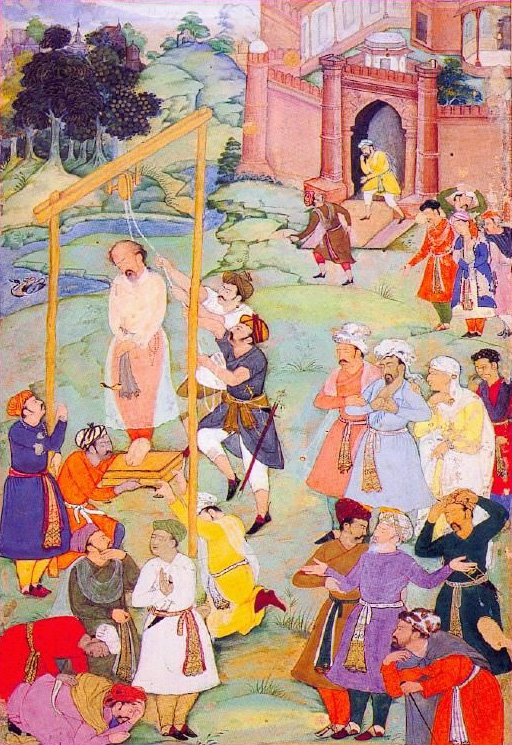
Hallaj-i Mansur, or Mansur al-Hallaj (August 858, Tur – 26 March 922, Baghdad), was a writer, poet, and Sufi mystic famous for being accused of heresy and, as a result of a long inquiry, executed by order of the Abbasid Caliph al-Muqtadir.
Life
His real name was "Abu'l-Mughith Husayn ibn Mansur ibn Muhammad al-Bayzawi." He received the epithet "Hallaj" (carder) from his father's profession.
He was born in the village of "Tur" in the Meyghan rural district of the town of Nehbendan, in the present-day South Khorasan Province of Iran during the Tahirid era. Hallaj-i Mansur's grandfather Mahamma the Magian was, like Bayazid Bastami's, a Zoroastrian. His father moved with his family to Wasit, a settlement region founded by the Arabs near the Tigris. Mansur became a hafiz there at the age of twelve. Hallaj was a Sunni Muslim.
His Education
He first became, for a short while, a disciple of Sahl al-Tustari, the student of Dhu'l-Nun al-Misri, who was also the master of the Sufi saint Bayazid Bastami. At the age of twenty he came to Basra. From there he went to Baghdad and attended the gatherings of well-known Sufis. Later he became the student of Amr al-Makki and Junayd al-Baghdadi. In 896 he went to the Hijaz to perform his first pilgrimage.
Spending his time here in worship, Hallaj then returned to Baghdad with a group of Sufis and continued to attend Junayd's gatherings. But because he fell into a difference of opinion with his teachers, he parted from them and returned to Tustar. Hallaj left Tustar to set out on a journey that would last five years. He traveled through the regions of Khorasan, Transoxiana, Sistan, and Kerman. In Fars he gave sermons to the people and wrote works for them. Then he crossed to Ahvaz and had his family brought there as well. Establishing an assembly in Ahvaz and beginning to give sermons, Hallaj won the great favor of the people and the intellectuals, and here he became known as "Hallaj-i Asrar" (Hallaj of the Secrets). Later, leaving his family in Ahvaz, he set out with 400 disciples by way of Basra to Mecca to perform the pilgrimage a second time.
After staying a month in Basra on his return from the pilgrimage, Hallaj came to Ahvaz, and taking his family and a group of the notables there with him, he crossed over to Baghdad. He stayed here a year; then, saying that he had received a spiritual sign to call the lands of unbelief and polytheism to the religion of God, he entrusted his family to one of his disciples and went by sea to India. He traveled through Khorasan, Talaqan, Transoxiana, Turkestan, Machin, Turfan, and Kashmir. Writing works for the people of the places he visited, he was influential in their embrace of Islam. Those who became Muslim through his influence were called Mansuri. This gained him great renown.
His Teaching and Ideas
Because of the words "Ana al-Haqq," that is, "I am the Truth (God)" (انا الحقّ, An al-Haqq), which Hallaj uttered in the sense of dissolving and vanishing into God, he was arrested in 912. This utterance also expresses the meanings of a person uniting and merging with God, of God being embodied in the person, or of the person's existence dissolving and vanishing within the existence of God (hulul), in other words of God's existence taking form in the person's body.
"Fi" and "An" (In Him and From Him)
The concept of "Fi" and "An," which is the essence of the Tasin doctrine of tawhid that Hallaj defended, differs from the doctrine of "Everything is God" in Wahdat al-Wujud, and means "Everything is in God and everything is from God."
His View of Other Faiths
The roots of the embracing, understanding-oriented approach seen in Sufis such as Yunus Emre, who came after him and who, with words such as "To look upon the seventy-two nations with a single eye," did not marginalize all differing beliefs and convictions, extend back to Hallaj-i Mansur. The following lines that the famous German scholar of Sufism Annemarie Schimmel conveyed from Hallaj show clearly how he regarded people of different faiths:
One of his students insults a Jew and incurs Hallaj's anger; after a while, having calmed down, Hallaj says to him: "My dear son. All religions are the religions of God Almighty. God occupies a separate community of people with each of His religions. People did not choose the religions they believe in themselves; rather, God, the Merciful and Compassionate, chose people for the religions they believe in. If one person reproaches another with the claim that the religion he believes in is not true, by this act he passes a judgment that that person has made a choice of his own will. This, in fact, is the manner of the Fatalists, and the Zoroastrians are such a religious community (that is, they are dualists). Know that Judaism, Christianity, and the other religions are only various titles and different names; but in all of them the aim is the same, not different. I have thought much about what religions are. In the end I saw that religions are the various branches of a single root. Do not demand of a person that he choose a religion that would divert him from his habits and sever him from his ties. He will in any case seek the cause of existence and the meaning of the lofty aims in the way he himself best understands."
In this universe of dualities, where everything is known by and stands upon its opposite, the dialectic of unbelief and faith is also a reality that cannot be ignored. Then, according to Hallaj, no one should regard himself, his convictions, as within a circle of absoluteness that excludes everything else. According to Hallaj, even God knows the limitation of His servant and treats him accordingly. Again, the following lines conveyed from him reveal the broad perspective of his view of the relationship between God and man:
His Death
Even while Hallaj was in prison, the activities against him continued with full force. When the demands for his punishment increased, he was brought once again before the panel of judges by the Vizier Hamid ibn Abbas with the demand for execution. Because the judges, saying that the evidence was insufficient, refrained from ruling for his execution, the trial dragged on. But in the face of Vizier Hamid's persistent pursuit and pressure, the Maliki qadi Abu Umar Muhammad ibn Yusuf al-Azdi ruled for his execution. Despite the opposition of the Hanafi qadi Ibn Buhlul, after this ruling was signed by the other qadis and witnesses and confirmed by the Caliph al-Muqtadir-Billah, Hallaj, on 26 March 922, was first flogged in the quarter of Baghdad called Bab al-Taq; after his nose, arms, and feet were cut off, he was executed. His head was cut off and set up on the bridge over the Tigris; his body was burned and its ashes scattered into the waters of the river. His severed head was left set up on the bridge for two days and then sent to Khorasan and paraded around the region.
The place where Hallaj was executed gained importance over time and began to be visited as the tomb of a saint who was a martyr of the Truth. That Ali ibn Maslama, newly appointed to the vizierate, before beginning his office visited the place known as Hallaj's grave, prayed in his spiritual presence, and made supplication, meant that the Abbasid State apologized to him and restored his honor. A mausoleum was built here in Hallaj's name.
The Reason for Hallaj's Execution
Various claims have been put forward concerning the reason for Hallaj-i Mansur's execution: that he secretly corresponded with the Qarmatians, who had risen against the Abbasids; that with the utterance "Ana al-Haqq" he claimed divinity (uluhiyya); and that he denied the obligatory nature of the pilgrimage and put forward a new understanding of the pilgrimage.
Hallaj's execution fatwa was a political rather than a religious decision, and could only be issued as a result of political pressures and intrigues. His having great fame, gathering around him a large number of disciples, finding supporters even at the court and among high-ranking statesmen and commanders, his sympathetic view of the Zanj Rebellion, and the emergence of rumors that he was the "Mahdi" and secretly cooperating with the Qarmatians against the Abbasids, alarmed the statesmen; therefore they obtained a fatwa from a panel of judges said to be working under pressure and carried out the execution. Hallaj's tomb is in Baghdad. He has tombs in many Islamic countries. All of these are cenotaphs (maqams). These tombs, said to number seven, are called the maqams of Hallaj-i Mansur. The tomb in the Gelibolu district of Çanakkale is also one of these seven maqams.
Sources
- Turkish Wikipedia: tr.wikipedia.org
- TDV Encyclopedia of Islam: islamansiklopedisi.org.tr
- English Wikipedia: en.wikipedia.org