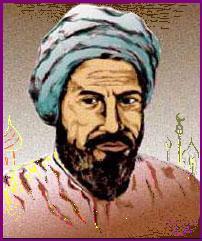
Ibn al-Nafis, or by his full name Abu'l-Hasan Ala al-Din Ali ibn Abi'l-Hazm Ibn al-Nafis al-Qarashi al-Dimashqi (birth: 607 AH / 1210 CE; death: 21 Dhu al-Qa'da 687 AH / 4 December 1288) (Arabic: علاء الدين أبو الحسن عليّ بن أبي حزم القرشي الدمشقي) (b. 1210 – d. 1288), was an Arab Islamic scholar and scientist. Ibn al-Nafis, who had works in many different fields, was a physician, anatomist, physiologist, surgeon, ophthalmologist (eye physician), psychologist, astronomer, cosmologist, and geologist. In addition to these, Ibn al-Nafis, who also had many works in the social sciences and humanities, was a hafiz, a muhaddith (hadith scholar), a Shafi'i jurist, a theologian, an Islamic philosopher, a sociologist, a novelist, a science-fiction writer, a grammarian, a linguist, and a historian. Ibn al-Nafis was born in Damascus and worked in Cairo.
Ibn al-Nafis is known for being the first to discover the pulmonary circulation along with the capillary and coronary circulations. For these constitute the basis of the circulatory system; indeed, on account of these discoveries he was regarded as the father of circulatory physiology and "the greatest physiologist of the Middle Ages."
Ibn al-Nafis was also an early advocate of experimental medicine, of post-mortem autopsy, and of human dissection. Being the first to define the concept of metabolism, Ibn al-Nafis additionally developed new systems of physiology, anatomy, psychology, and pulse that diverged from the anatomical and medical systems of Avicenna and Galen; in these systems he did not include the various physiological, anatomical, and other errors put forth or accepted by the physicians before him, and in his new physiological system he used various diagrams and figures to depict the parts of the body.
Medical Works
Ibn al-Nafis was born in Damascus and also learned medicine at the Nuri Hospital founded by a Turkic sultan, Nur al-Din Mahmud Zangi. In time he became chief physician and began to be known and to work as the physician of political leaders.
In 1236 he went to Cairo to give legal instruction, and in this respect he became an important figure of his era, especially in the field of religious law. In his thirties he produced his well-known famous medical book titled Kitab al-Shamil fi al-Sina'a al-Tibbiyya (The Comprehensive Book on the Art of Medicine). This comprises a system of notes with 300 headings, of which 80 were printed. These writings have been housed and cataloged in many libraries, foremost among them the Cambridge University Library, the Bodleian Library, and Stanford University's Lane Medical Library. His work titled Kitab al-Shamil reflects medicine and human relations from his perspective, but it was never printed.
According to his writings describing his approach to surgery, he summarizes this procedure in three steps: the first step is to inform the patient and explain how the intervention will proceed; the second step is to perform the surgical procedure; the last stage is post-surgical assessment and follow-up. Along with these, he also made explanatory descriptions of how the surgeon's relations with other surgeons, with nurses, and with the patient should be.
Returning to his most comprehensive book, al-Shamil fi al-Tibb, it is possible to see that this book was unfortunately not fully completed by the time of his death. The original manuscript of this book is in Damascus. Ibn al-Nafis, who also had intensive studies in the field of ophthalmology, had theology as another of his fields of study.
Perhaps Ibn al-Nafis's most important feature for physicians working in the field of pulmonary vascular diseases is that he was the first to describe the pulmonary circulation. In 1924, an Egyptian physician, Muhyo al-Deen al-Tatawi, saw in the Sharh Tashrih al-Qanun li-Ibn Sina (Commentary on the Anatomy of Avicenna's Canon), one of the manuscripts he was working on regarding Islamic medicine in a library in Berlin, that the pulmonary circulation was examined in detail on the basis of anatomy, physiology, and pathology. The previous description belonged to Galen, and it explained that the blood was exchanged between the right and left sides through pores located in the septum of the heart. This manuscript was translated by Max Meyerhof, and here it was seen that Ibn al-Nafis criticized Galen's theory and described how, through the chamber systems of the heart, the blood went from the heart to the lung via the pulmonary artery and returned from there to the heart via the pulmonary vein. He also drew attention to some points concerning circulation here;
Other Works
In addition to his contributions to medical science, he also wrote works on the Islamic religious sciences; his work titled Mukhtasar fi 'Ilm Usul al-Hadith ("A Brief Explanation of the Methodology of Hadith"), which he wrote on the science of hadith, is especially significant, for in this work he put forward a more rational and logical classification for the science of hadith. He also produced Arabic literary works and contributed to fictional literature. The most noteworthy of these is the work titled al-Risala al-Kamiliyya fi'l-Sira al-Nabawiyya (Theologus Autodidactus). In the story, the process of coming of age of a child who remains on a desert island is treated; using this narrative basis, Ibn al-Nafis put forth various religious, philosophical, and scientific themes and his views.
His Death
Before his death, Ibn al-Nafis donated all his works to the Qalawun Hospital, and he died in Cairo in 1288.
Sources
- Turkish Wikipedia: tr.wikipedia.org
- TDV Encyclopedia of Islam: islamansiklopedisi.org.tr
- English Wikipedia: en.wikipedia.org