Ibn al-Shatir (b. 1304, Damascus – d. 1375, Damascus) was an Arab astronomer who lived in the 14th century.
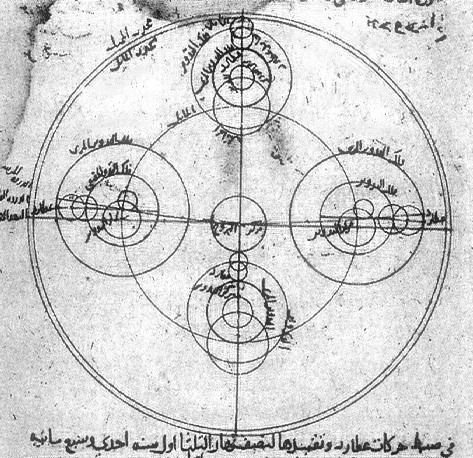
At the age of 10 he went to Cairo and Alexandria to study astronomy. Later, returning to his hometown of Damascus, he was appointed timekeeper (muwaqqit) of the Umayyad Mosque. During his tenure here he made precise measurements of the movements of the moon and the planets, examined Ptolemy's geocentric system, and laid the foundations of Copernicus's heliocentric system.
Works
Nihayat al-ghayat fi'l-a'mal al-falakiyyat (an astronomical handbook, mentioned in Zij Ibn al-Shatir)
Nihayat al-sul fi tashih al-usul
Ta'liq al-arsad (a work on astronomical observations, cited in the zij)
Zij Ibn al-Shatir (al-Zij al-jadid). The author's most important work.
A table showing the prayer times for the latitude of 34° (Cairo, Dar al-Kutub al-Misriyya, Miqat, no. 1170, fols. 11a–22b), discovered in 1974.
al-Naf' al-'amm fi'l-'amal bi'l-rub' al-tamm. It gives information about the al-rub' al-tamm (complete quadrant) that he himself made.
Tuhfat al-sami fi'l-'amal bi'l-rub' al-jami'. Concerning the al-rub' al-jami' instrument, known from its extant summary titled Nuzhat al-sami fi'l-'amal bi'l-rub' al-jami'.
al-Ashi'a al-lami'a fi'l-'amal bi'l-ala al-jami'a. Concerning how to use the spherical astrolabe called al-ala al-jami'a, of which two examples exist.
al-Rawdat al-muzhirat fi'l-'amal bi-rub' al-muqantarat. Concerning the quadrant board known as al-muqantar.
Risala fi'l-rub' al-'Ala'i. On the quadrant board that bears Ibn al-Shatir's own name.
Mukhtasar fi'l-'amal fi'l-usturlab wa-rub' al-muqantarat wa-rub' al-mujayyab
Sources
- Turkish Wikipedia: tr.wikipedia.org
- TDV Encyclopedia of Islam: islamansiklopedisi.org.tr
- English Wikipedia: en.wikipedia.org