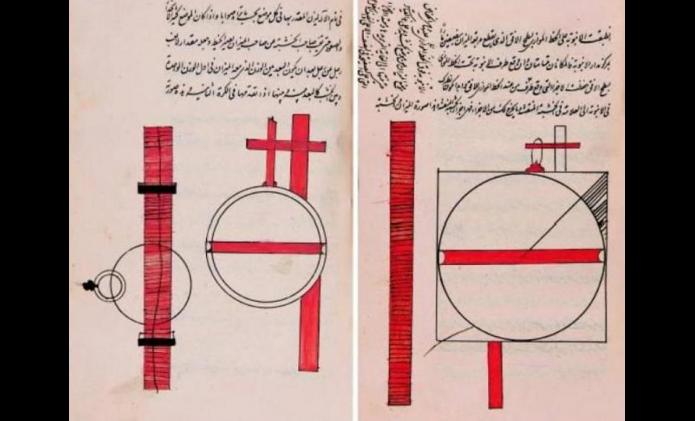
Al-Karaji, or Ebu Bekir bin Muhammed bin el-Hüseyin el-Kereci (Arabic: الكرخي; b. 953 - d. 1029), was a 10th-century Persian Muslim mathematician and engineer who, by freeing algebra from the limits of geometric operations, formed the core structure of algebra as used in present-day mathematics. His three great works are Al-Badi' fi'l-hisab (The Marvelous in Calculation), Al-Fakhri fi'l-jabr wa'l-muqabala (The Extraordinary in Algebra), and Al-Kafi fi'l-hisab (The Sufficient in Calculation).
It is reported that he was born in Karkh, a suburb of Baghdad. What is certain is that he spent the greater part of his life in Baghdad. Because the original Arabic texts have been lost, it is thought that al-Karaji's name may have been al-Karkhī.
Contributions to science
The greatest contribution of al-Karaji, a highly talented engineer and mathematician, was the table of the Binomial Coefficients, whereby for an integer n a polynomial given in the form
{\displaystyle (a+b)^{n}=\sum _{k=0}^{n}{n \choose k}a^{k}b^{n-k}}
can be formulated in the form
{\displaystyle {n \choose m}={n-1 \choose m-1}+{n-1 \choose m}}
.
Al-Karaji proved the Binomial expansion and Pascal's Triangle using the method of mathematical induction. This proof is one of the earliest proofs made for a successive sequence, which would be set forth by Al-Fakhri in the 1000s CE. Apart from his great contributions to algebra, al-Karaji also had works in various fields of geometry. In his book "The Measurement and Balance of Buildings and Structures," he defined the point, the line, the plane, space, and the angle.
His official work carried out under the Baghdad administration, "The Sufficient in Calculation," was in the nature of a textbook for the officials in Baghdad. In the book were the taking of the square roots of integers and fractional numbers and the calculation of areas and volumes.
Sources
- Turkish Wikipedia: tr.wikipedia.org
- TDV Encyclopedia of Islam: islamansiklopedisi.org.tr
- English Wikipedia: en.wikipedia.org