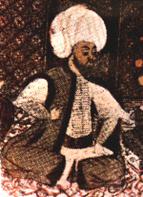
Al-Kindi, or by his full name Ebu Yusuf Yakub bin İshak el-Sebbah el-Kindî (Arabic: أبو يوسف يعقوب بن إسحاق الصبّاح الكندي; b. 801, Basra - d. 873, Baghdad), was an Arab scientist who wrote works in many branches of science, from philosophy, medicine, mathematics, astronomy, theology, psychology, physics, and chemistry to music.
Receiving special interest and support from the Abbasid caliphs, al-Kindi also carried out the office of court astrologer (müneccim) as an astronomer and astrologer at the court. He also took charge of the education of Ahmed, the son of the caliph Mu'tasim. Al-Kindi wrote an important part of his works at the request of this crown prince, with whom he had a closeness based on a friendship beyond the teacher-student relationship, and he also dedicated his works to this crown prince. Known in medieval Europe by the name "Alkindus," he is the first Islamic philosopher. In his philosophy he made a synthesis of the views of Plato, Aristotle, and Plotinus. According to al-Kindi, who held that the method of philosophy is demonstration, that the aim of demonstration is to know the essences that give form to matter, and that the purpose of philosophy is to reach God, the first step of philosophical knowledge is reasoning. Holding that man rises step by step, through reasoning, from the simple to the compound and to the most perfect, the philosopher, because he approached being from a rationalist point of view, denied the attributes belonging to the essence of God. According to El-Kindî, who argued that God's attributes can only be known in a negative manner, God is the absolute One. Because it is absolute being, the absolute One has no shape, quality, quantity, or matter, and it is not a relative being.
He was born in Kufa as the child of a noble family. His grandfather Eş'as was the ruler of Kinde, one of the largest tribes of South Arabia. After becoming a Muslim, he had settled in Kufa with the notables of his tribe. His father İshak b. es-Sabbah served for years as governor of Kufa.
There is no clear information about al-Kindi's date of death, just as with his date of birth. Although different dates such as 860, 869, 870, and 873 appear as the date of the philosopher's death, Mustafa Addurrâzık, giving certain reasons, stated that al-Kindi may have died in the year 866. Some sources say that there were diseases that caused his death and that the philosopher may have died on account of his chronic rheumatic ailment. (Kaya, 2002:3-6)
He lost his father at a young age. Al-Kindi, whose childhood and early youth were spent in Kufa and Basra, received an education in the field of language and literature after the traditional basic education. He took his place among the community of scholars at the Beytü'l-hikme (House of Wisdom) that the caliph Me'mun founded in 830. Receiving support from Mu'tazilite state administrators, al-Kindi remained away from the court during the rule of the pro-Ahl al-Sunna Mütevekkil-Alellah (al-Mutawakkil).
Life
Al-Kindi came into the world in 801, in the house of one of the elders of the Kinde tribe. He completed his first education from his father, who was the chief of the Kinde tribe. Then he went to Baghdad. He attracted the attention of the caliphs Memun and Mutasım (Abbasid), and Memun appointed him as an administrator to the Beyt'ül Hikmet. The reason for al-Kindi's appointment was the translations he made in Baghdad from Ancient Greek philosophy and scientific texts. Al-Kindi is also known for his beautiful oratory. Indeed, the caliph Mütevekkil (Abbasid) chose him as his private orator.
When Mutasım (Abbasid) came to the caliphate in place of his brother Memun, he assigned al-Kindi as the tutor of his children. However, al-Kindi wanted to remain at the Beyt'ül Hikmet. There are many interpretations of this event. Although some interpret this situation as being due to the rivalry that existed at the Beyt'ül Hikmet, others have interpreted it as al-Kindi's wanting to specialize more in the field of religion; indeed, for this reason al-Kindi encountered a number of difficulties, and for a period his manuscripts were confiscated. Henry Corbin—a researcher of Islamic subjects—said that al-Kindi died alone in Baghdad in the year 259 AH (873 CE) during the period of Mutasım (Abbasid).
After his death, many of al-Kindi's works in the field of philosophy perished or were lost. Felix Klein Franke said there were many reasons for this; these were: his drawing attention with his harsh criticisms in the field of religion; another reason being the Mongols' destroying these works during their invasion of Baghdad; and, in addition to these reasons, most likely the fact that his writings were not accepted by the philosophers who came after him, such as the famous Farabi and Avicenna (Ibn Sina).
Contributions to science
Al-Kindi was a scholar in subjects other than the field of thought as well. Despite the works of Farabi and Avicenna, he too was counted among the Great Muslim Philosophers of the century in which he lived. The historian İbnünnedim (Ibn al-Nadim) mentioned him in his book titled Fihrist (Catalogue). Likewise, the Renaissance-era Italian researcher Gerolamo Cardano spoke of him thus: "He is one of the twelve greatest minds of the Middle Ages."
Astronomy
Al-Kindi supported Ptolemy's "Solar System" theory. This theory says that the Earth is the center of various systems and that the known planets—the Moon, Mercury, Mars, Venus, the Sun, and Jupiter—revolve in this orbit. Al-Kindi said of this theory: "Rational beings revolve within an orbit, and their revolution takes the form of obedience and submission to God." But there is this, that this saying became a mystery with the influence of celestial beings upon the material world.
However, al-Kindi fell into uncertainty on the question of how the influence upon the real world by spiritual beings comes about. In a theory in which he was inspired by Aristotle, al-Kindi conceives that the movements of these bodies cause friction in the sublunary region and, in the first stage, form what is thought to be earth, fire, water, and air, and that this combination produces everything in the material world.
Al-Kindi collected his clear thoughts on the subject of astronomy in his book titled "The Law in the Stars," which consists of 40 chapters and contains questions and answers and the theses "Change of Weather," "Solar Eclipse," and "Rays of the Stars."
Works
Risale fi Mahiyyetin Nevmi ver hayali beser.
Risale fil Cevahiril Hamse.
Risale fil illetis Selci vel Berdi vel Berki ves Savaiki ver Radi vez Zemherir.
Risale fi Vel Elel Hesana İhtiyaratil Eyyam.
De İntellecto Secondum Aristoteles et Platonem.
Risale fi İhtilafil Manazır.
Fi Marifeti Kuval Edviyetil Murekkebe.
Risale fi'l-İlleti'i-Levni'l-Lazeverdi
Risale fi´l-hile li-def´i´l-ahzan.
Risaletü Eflatun ila Furfuriyus fi hakikati nefyi´l-hem.
Sources
- Turkish Wikipedia: tr.wikipedia.org
- TDV Encyclopedia of Islam: islamansiklopedisi.org.tr
- English Wikipedia: en.wikipedia.org