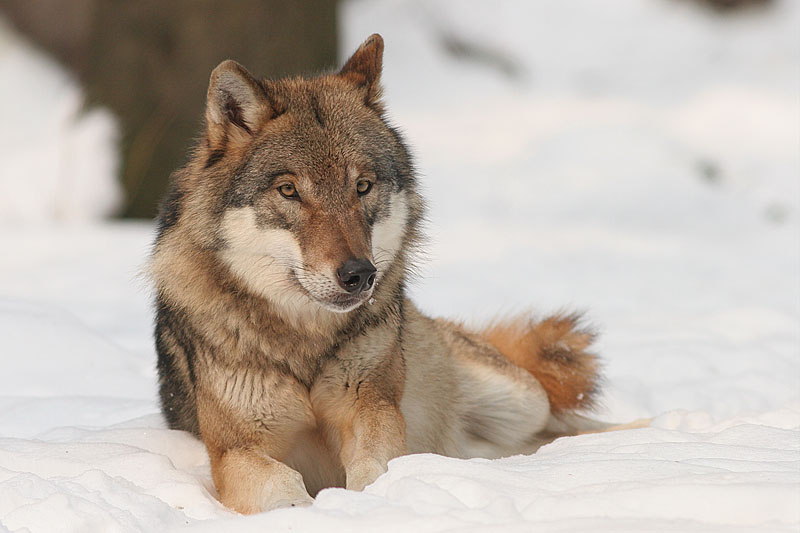
The Grey Wolf (Bozkurt) is a sacred animal and national symbol in Turkic, Mongol, and Altai mythology. It is also pronounced Boskord and Pusgurt. The words Bozkaskır and Çalkurd likewise carry the same meaning. The Mongols call it Börteçine (Börteşına, Börtöşono). The epithets Gökkurt or Gökbörü, and Kökbörü, are also used descriptively.
Its place and importance in Turkic mythology
As a guide and blessed wolf, it is the common totem (ongun) of all Turkic and Mongol tribes. Some Turkic and Mongol tribes believe that their lineage descends from this blessed being. The wolves that stand at the head of and lead the packs are also called Gökkurt. The words Kaskır and Börü also mean wolf in various dialects and accents. The Grey Wolf represents the sky, while the fallow deer (Alageyik) is the symbol of the earth. On the sky-blue banners of the Göktürks there is a wolf's-head image. It represents martial prowess and the spirit of war, freedom, speed, nature and reason, and the power to read the terrain. When some misfortune befalls the Turkic nation or a threat arises, it appears and shows the way. Poles topped with a golden wolf's head were erected in front of the tents. The War Spirit (God) takes on the appearance of a wolf. On a stone monument dating to the sixth century, a child suckling from a wolf is depicted. Saints and holy men at times take the form of a wolf. The Grey Wolf is also called the "Son of the Sky" (Gök Oğlu). In folk culture it is believed that carrying a Grey Wolf's tooth in one's pocket protects against the evil eye. In Yakut texts it is mentioned as Bosko. Among the Kyrgyz, seeing a wolf while roaming the steppe is a good omen. Seeing a wolf in a dream is likewise interpreted as auspicious. To protect a pregnant woman from the evil eye, a wolf's tooth or hide is placed under her pillow. A wolf falling upon a flock of sheep or entering the barn was considered a sign of abundance. According to Bashkir traditions, a wolf went before their ancestors and guided them; for this reason they were called Başkurt, meaning "those with a wolf at their head." The crescent tactic (also called the Turan/Turkic tactic), the strategy of enveloping the enemy within a half-circle and closing the ring, was first applied by the Turks, having been observed from wolves.
In the pre-Islamic period the Grey Wolf was regarded as sacred by the Turks, and in later periods it continued to be a symbol of Turkishness. Historical research shows that this symbol was used to express their lineage by various Turkic peoples such as the Huns, Kipchaks, and Pechenegs who migrated westward. The most important reason the Grey Wolf came to be regarded as sacred and to become the national symbol of the Turks rests, as recounted in the Epic of Ergenekon, on the belief that a she-wolf named Börteçine (the Grey Wolf) guided the Turks as they melted the iron mountains and emerged from Ergenekon. Today the Grey Wolf is the symbol of Turkish nationalism. It was declared a national symbol by Atatürk as well and used in many places. In the early years of the Republic, images of the grey wolf were printed on Turkish currency.